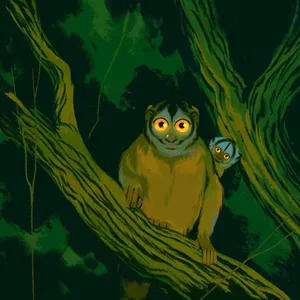
Animal dads get a surprising spotlight in this Father’s Day bonus episode
This show-notes preview points to a family-friendly Terrestrials bonus about fatherhood in the animal world. Expect examples that challenge the stereotype of distant or aggressive dads, alongside reflections from researcher Eduardo Fernandez-Duque and father Michael Feigelson.
This is a preview based on the published show notes, not a recap of the audio. If you’re curious about a lighter, family-friendly science listen for Father’s Day, this bonus episode looks designed to widen the idea of what a dad can be. According to the notes, the episode starts from a familiar stereotype: animal fathers are often framed as absent, aggressive, or useful mainly as protectors and providers. From there, it appears to pivot toward a more varied picture of caregiving in nature. The featured guides are two human dads: Dr. Eduardo Fernandez-Duque, who studies owl monkey fathers in Argentina, and Michael Feigelson, who brings a personal angle about wondering whether he was suited to the gentler side of parenting. The animal lineup sounds especially appealing for listeners who like vivid, kid-friendly examples. The notes mention seahorse dads that get pregnant, poison dart frog dads carrying tadpoles, Darwin frogs protecting eggs by swallowing them, burying beetles building “corpse cribs,” jacana birds handling egg-sitting, and stickleback fish making underwater nests. Even without hearing the episode, the theme is clear: nature offers multiple models of fatherhood rather than one fixed script. This may be a good pick if you enjoy science stories that connect animal behavior to human questions without sounding overly heavy. It also seems well suited for parents listening with kids, or anyone interested in how caregiving shows up across species.
About this episode
<p>In honor of Father's Day, here is a family friendly bonus episode from our kids' podcast <a href="https://www.wnycstudios.org/podcasts/radiolab-kids" target="_blank" rel="noopener noreferrer"><i>Terrestrials</i></a><i>.</i> <br><br> What does it really mean to be a dad? In the animal world, fathers have long been painted as aggressive or absent. At best providers and protectors, but certainly not caregivers. And yet for every tale of a lion or chimp dad eating its own young (yikes!), there’s another creature who tells a sweeter story. </p> <p>Two HUMAN dads bring us on this DADventure: <a href="https://anthropology.yale.edu/profile/eduardo-fernandez-duque" rel="noopener noreferrer">Dr. Eduardo Fernandez-Duque</a>, who has spent decades studying owl monkey dads in the forests of Argentina, and <a href="https://vanleerfoundation.org/team/michael-feigelson/" rel="noopener noreferrer">Michael Feigelson</a>, who once worried he wasn't cut out for the softer side of parenting. </p> <p>They introduce us to seahorse dads who get pregnant, poison dart frog dads who give piggyback rides to their tadpoles, Darwin frogs who swallow their eggs to keep them safe, burying beetles who build "corpse cribs," jacana birds who do all the egg-sitting, and stickleback fish who construct intricate underwater nests for their young. Along the way, we learn that nature doesn’t offer just one model of fatherhood. Alongside Mother Nature... there just might be a Father Nature, too.</p> <p>Special thanks to the <a href="https://vanleerfoundation.org/" rel="noopener noreferrer">Van Leer Foundation</a> for the support of this episode. </p> <p>Resources on Animal fatherhood</p> <ul> <li>Eduardo Duque's Owl Monkey Project: <a href="https://www.owlmonkeyproject.com/" rel="noopener noreferrer">https://www.owlmonkeyproject.com/</a></li> <li><a href="https://url.us.m.mimecastprotect.com/s/YJfQCPN9OMSAqM7Xs6t1cxpHrs?domain=news.yale.edu" rel="noopener noreferrer">An interview with Eduardo in Yale News</a></li> <li><a href="https://url.us.m.mimecastprotect.com/s/eYuMCQW2PNc4mr5PhAuocG7r7W?domain=laurenoconnelllab.com" rel="noopener noreferrer">Lauren O’Connell lab – frog behaviour</a></li> <li><a href="https://url.us.m.mimecastprotect.com/s/y0xcCR60QMiP8BAWcQCnc1git6?domain=youtube.com" rel="noopener noreferrer">Short explainer: frog parenting research</a></li> <li><a href="https://url.us.m.mimecastprotect.com/s/zHCECVOkX5Ij19DyCEF1cEVgL8?domain=royalsocietypublishing.org" rel="noopener noreferrer">Stickleback fish parenting study (Alison Bell)</a></li> <li><a href="https://url.us.m.mimecastprotect.com/s/ULFGCW6lYwiwvGAqhOHLcotRmz?domain=youtube.com" rel="noopener noreferrer">Alison Bell lab video</a></li> </ul> <p>Human fatherhood </p> <ul> <li><a href="https://url.us.m.mimecastprotect.com/s/jrrACXD0Z7U730xKFQIncWZeqc?domain=citrona.com" rel="noopener noreferrer"><i>Fathertime</i> by Sarah Blaffer Hrdy</a></li> <li><a href="https://url.us.m.mimecastprotect.com/s/QSCxCYEn1QhoPOzlFQS5cxScI0?domain=earlychildhoodmatters.online/" rel="noopener noreferrer">ECM interview: evolution of “man the nurturer”</a></li> <li><a href="https://url.us.m.mimecastprotect.com/s/OWiPCZ6o2winy23gFRTwcBOyix?domain=youtube.com" rel="noopener noreferrer">Lee Gettler – biology of fatherhood (video)</a></li> <li><a href="https://url.us.m.mimecastprotect.com/s/GyPYC1wnXYiwK57Gh4UKcV8K1G?domain=earlychildhoodmatters.online/" rel="noopener noreferrer">Lee Gettler article in Early Childhood Matters</a></li> <li><a href="https://url.us.m.mimecastprotect.com/s/mnMGC2koYghoAON3FxcJc5oeWb?domain=darbysaxbe.com" rel="noopener noreferrer">Darby Saxbe book: Dad Brain</a></li> <li><a href="https://url.us.m.mimecastprotect.com/s/QmkAC31pZjiYV05Ks5fRcQG3JG?domain=earlychildhoodmatters.online/" rel="noopener noreferrer">Darby Saxbe Article in Early Childhood Matters</a></li> </ul> <p>Talks, films & convenings</p> <ul> <li><a href="https://url.us.m.mimecastprotect.com/s/enhVC4xq1kCAG3p5sqhjc4Vgdr?domain=alumniacademy.yale.edu" rel="noopener noreferrer">Yale Conference on Fatherhood</a></li> <li><a href="https://url.us.m.mimecastprotect.com/s/QpshC5yr2lFYO4V9sPi5ckwJZT?domain=youtube.com" rel="noopener noreferrer">Live Recording of Yale Conference: </a></li> <li><a href="https://url.us.m.mimecastprotect.com/s/QpshC5yr2lFYO4V9sPi5ckwJZT?domain=youtube.com" rel="noopener noreferrer">Fathers and Fatherhood: From Molecules to Modern Families</a></li> <li><a href="https://url.us.m.mimecastprotect.com/s/SxTOC68v3milx8nmSws3c5yFVT?domain=vimeo.com" rel="noopener noreferrer"><i>Fathertime</i> documentary</a></li> </ul> <p>Campaigns & global perspectives</p> <ul> <li><a href="https://url.us.m.mimecastprotect.com/s/ftJEC73wgnhj9oONCGt5cojQKf?domain=equimundo.org/" rel="noopener noreferrer">Equimundo's State of World's fathers report</a></li> <li><a href="https://url.us.m.mimecastprotect.com/s/Z0LdC82xjoU8xL7qtYujcyB2ek?domain=changemakers.equimundo.org/" rel="noopener noreferrer">Men Care Changemakers Journey</a></li> <li><a href="https://url.us.m.mimecastprotect.com/s/v2DNC9rykpUVP95qfRCJcq47uY?domain=parentingoutloud.com/" rel="noopener noreferrer">Parenting Out Loud (Elliot Rae)</a></li> </ul> <p>Terrestrials was created by Lulu Miller with WNYC studios. This episode was produced by Tanya Chawla, with sound design by Mira Burt-Wintonick. Sarah Sandbach is our Executive Producer. Our team also includes Ana González, Alan Goffinski, Natalia Ramirez, and Joe Plourde. Fact checking by Angely Mercado. </p> <p><i>Signup for our newsletter!! It includes short essays, recommendations, and details about other ways to interact with the show. </i><a href="https://radiolab.org/newsletter" rel="noopener noreferrer"><i>Sign up</i></a><i> (https://radiolab.org/newsletter)!</i></p> <p><i>Radiolab is supported by listeners like you. Support Radiolab by becoming a member of </i><a href="http://members.radiolab.org" rel="noopener noreferrer"><i>The Lab</i></a><i> (https://members.radiolab.org/) today.</i></p> <p><i>Follow our show on </i><a href="http://instagram.com/radiolab" rel="noopener noreferrer"><i>Instagram</i></a><i>, </i><a href="http://twitter.com/radiolab" rel="noopener noreferrer"><i>Twitter</i></a><i> and </i><a href="http://facebook.com/radiolab" rel="noopener noreferrer"><i>Facebook</i></a><i> @radiolab, and share your thoughts with us by emailing </i><a href="mailto:radiolab@wnyc.org" rel="noopener noreferrer"><i>radiolab@wnyc.org</i></a><i>.</i></p> <p><i>Leadership support for Radiolab’s science programming is provided by the Simons Foundation and the John Templeton Foundation. Foundational support for Radiolab was provided by the Alfred P. Sloan Foundation.</i></p><br/> <p>Hosted by Simplecast, an AdsWizz company. See <a href="https://pcm.adswizz.com">pcm.adswizz.com</a> for information about our collection and use of personal data for advertising.</p>